




We work with senior leaders, in partnership and in confidence.
The market has never lacked creative definitions of performance. Ahead of its 2018 bond offering, WeWork asked investors to judge it on “Community Adjusted EBITDA” – earnings before interest, tax, depreciation and amortisation, adjusted further still. The measure stripped out rent, utilities and staff salaries, the company’s largest expense category.1 Groupon had set the precedent seven years earlier. It filed to go public on a metric that removed the marketing spend it depended on to acquire customers, turning a US$420 million operating loss into US$60.6 million of “profit”. Both measures shared the same flaw: the company, not the framework, decided what performance meant. Both drew investor criticism over the ambiguity they created around underlying value.
These were not isolated cases but symptoms of a wider gap. With little in the accounting framework to constrain them, companies could define “performance” largely as they saw fit, leaving investors to reconcile the results. That is precisely what IFRS 18 sets out to change. The International Accounting Standards Board (IASB) issued IFRS 18 Presentation and Disclosure in Financial Statements in 2024, after years of investor feedback that self-defined subtotals made companies hard to analyse and compare. It takes effect for annual periods beginning on or after 1 January 2027. The standard leaves the final profit and cash figures untouched. What it does change is how performance is presented, how far issuers can define their own metrics and, for the first time, whether certain non-GAAP measures sit inside the audited financial statements.
Our interest here is less in the mechanics of the standard than in the communication challenge it creates. IFRS 18 will move headline figures the market has anchored to for years. It might unsettle metrics embedded in debt covenants and remuneration schemes. And any issuer that manages the transition quietly will face a market that fills the silence with its own conclusions.
What IFRS 18 changes
The standard makes three main moves. First, it classifies all income and expenses into one of five categories: operating, investing, financing, income taxes and discontinued operations. The first three are new. They echo the familiar split of the cash flow statement, but they are defined differently enough that the two should not be equated. Two subtotals also become mandatory on the face of the income statement: operating profit, and profit before financing and income taxes.
The second concerns management-defined performance measures (MPMs): company-specific subtotals used in public communications, with headline “adjusted operating profit” or “adjusted EBITDA” being the typical examples. Each must now appear in a single note, with an explanation of why it is useful, how it is calculated and a reconciliation to the nearest IFRS subtotal, including the tax effect of every reconciling item. That note sits inside the audited financial statements, so these measures now attract audit and regulatory scrutiny that many non-GAAP figures have historically escaped.
The third is a set of tighter principles on aggregation and labelling. They govern what may be combined into a single line and what must be broken out, and allow “other” only where no more informative label exists.
The category rules differ for entities whose main business is investing in assets or providing financing to customers. Banks and property companies are the obvious cases: income that an industrial company would place below operating profit sits within it, because it is the main business. Operating profit will therefore be drawn differently across sectors – correctly so – and cross-sector comparisons will need to respect that.
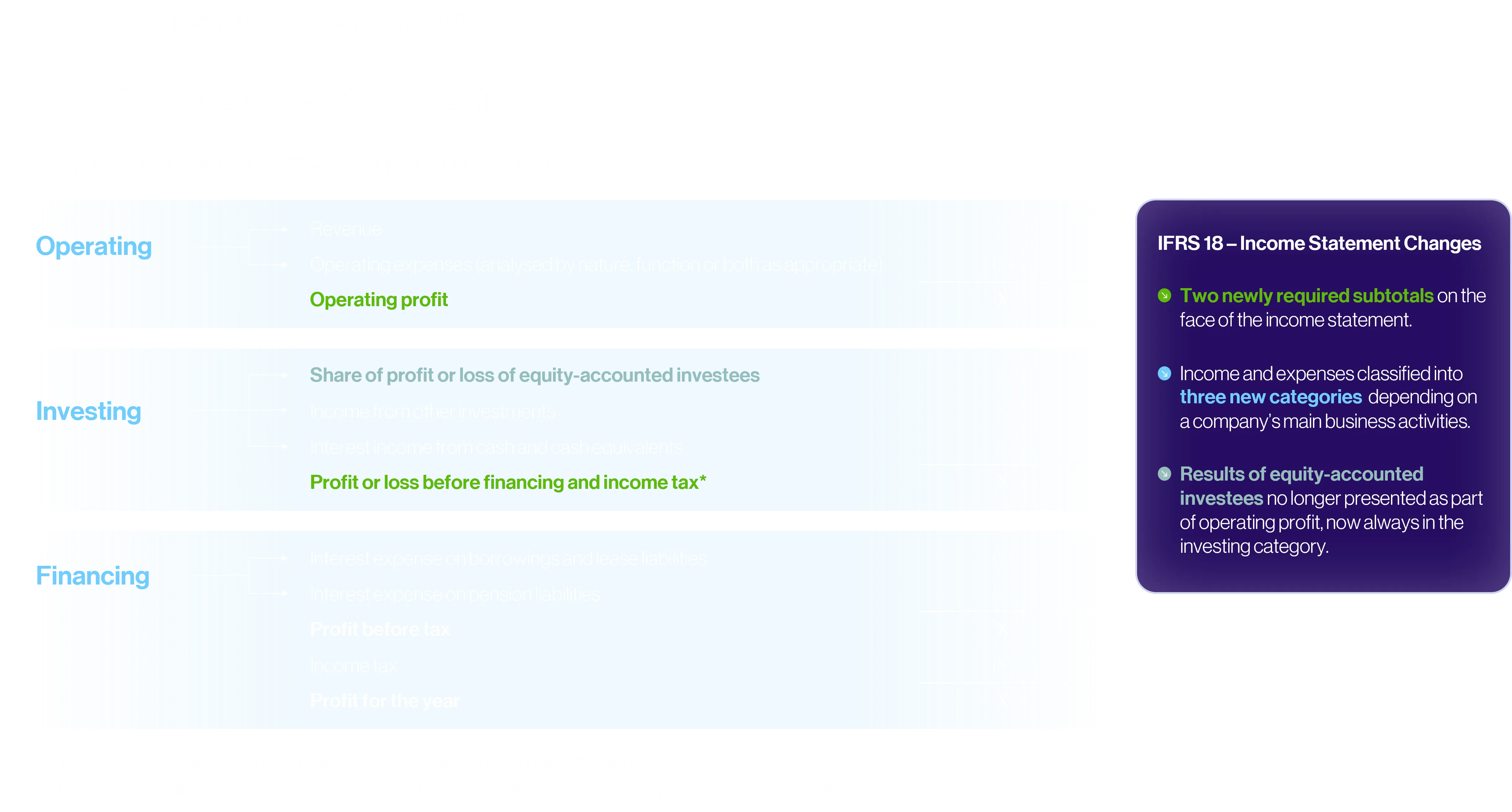
Source: KPMG2
Why IFRS 18 may change reported performance
Operating profit becomes a common language and may move as a result. Today each company draws the line slightly differently. Under IFRS 18, it is a defined subtotal built from standard categories. That improves comparability, but it also means many issuers’ reported operating profit will shift, sometimes materially, simply because items are reclassified. A company’s share of profit from equity-accounted associates and joint ventures, for instance, now always sits below operating profit in the investing category. For most companies that is a relabelling. For those that currently include it higher up – Vodafone among them – the headline moves.3 The narrowing of the financing category cuts the other way: card commissions, routine bank fees and operating-related foreign exchange differences are not interest on a financing liability, so they fall into operating instead and can nudge the figure down.
The cash flow statement will change too. The amended IAS-7 fixes the indirect method’s starting point as operating profit and removes the freedom to classify interest and dividends. Reported net cash from operating activities will therefore move: upward where interest paid shifts out to financing – Tesco, for one, currently reports interest paid within operating cash flow – and downward where finance-type operating costs can no longer be added back.
EBITDA itself deserves particular attention. The IASB considered defining it and declined, observing that beyond a rough starting point for analysis there is no common understanding of what it represents. The standard instead carves out one subtotal from the MPM regime: operating profit before depreciation, amortisation and impairments. A company computing exactly that figure escapes the reconciliation note, though it must describe the measure in full rather than label it as “EBITDA”. A bespoke “adjusted EBITDA” that goes further – stripping out restructuring or “non-recurring” items – falls outside the carve-out and becomes an MPM carrying the full disclosure.
None of this changes what a business is worth. Net profit and total cash generation remain unchanged. What changes are the reported figures the market anchors to: operating margins, EBITDA-based multiples, free cash flow proxies and the consensus models built on them. The shift arrives at once, on restated comparatives. Remuneration policies and debt covenants tied to the old metrics may also need revisiting. The main risk is not a change in value but a change in the numbers used to assess it.
Leveraging investor communication to smoothen the IFRS 18 transition
The first priority is to build the bridge before you need it. IFRS 18 applies retrospectively, so comparatives must be restated. The standard also requires a reconciliation between the old and new presentation for the year immediately before first application. For a December year-end adopter, this means showing the 2026 figures alongside the first 2027 accounts. The single most valuable investor communication tool an issuer can prepare is therefore a bridge from today’s key performance metrics, EBITDA above all, to the IFRS 18 equivalents, showing exactly which items have moved and why.
The second is to brief analysts before the numbers do. Regulators expect early, transparent communication rather than a surprise in the 2027 accounts. The European Securities and Markets Authority (ESMA) points issuers to IAS 8, which requires disclosure of the known or reasonably estimable impact of a standard that is issued but not yet effective. ESMA expects reports published before January 2027 to describe the coming changes to the income statement, the issuer’s assessment of its main business activities and which measures are expected to qualify as MPMs. It goes further, encouraging issuers to disclose the expected change in 2026 operating profit as their assessment matures.4 From a communications perspective, even a qualitative heads-up on what will move, and roughly by how much, is enough to reset expectations and carry consensus across the transition.
The third is to engage the right people early, inside and out. Identifying MPMs and preparing the disclosures will require closer collaboration between financial reporting, legal and investor relations than is currently the norm. Auditors should come in early, and the changes reach beyond the accounts into data collection, reporting systems and the close process. Treated in the right spirit, that work is less a burden than a natural moment to revisit how the company communicates its financial performance to analysts and investors.
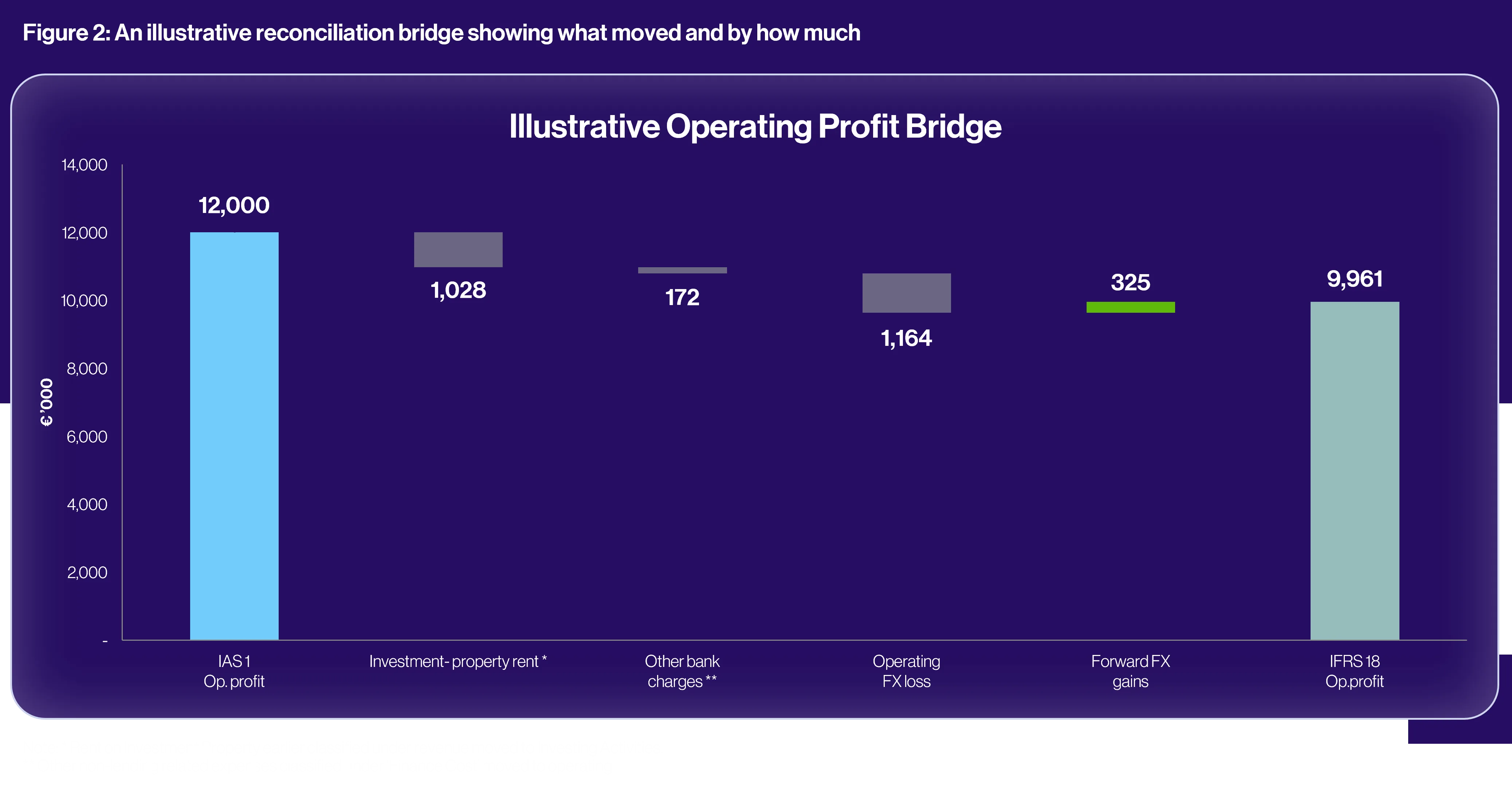
IFRS 18 is both a reporting process and a communication opportunity
IFRS 18 is, at heart, a process that requires companies to restate comparatives, assign categories, update systems, prepare the MPM notes, build a clear bridge and tell a story. None of it changes what the business is worth, and for a well-resourced issuer the work is manageable with adequate lead time. But late preparation creates communication risk. A 2027 income statement that looks materially different from the 2026 presentation, without prior explanation, invites the assumption that something has deteriorated when nothing has.
Handled well, the transition creates an opportunity. Companies can explain what is moving, why underlying performance is unchanged and how the new subtotals map to the equity story. That also gives investor relations teams a rare, framework-mandated reason to get in front of analysts and investors, including those who have been slow to engage. Issuers that treat the time between now and 2027 as the window to prepare that bridge and open that dialogue will not merely comply with IFRS 18, but also strengthen the relationships that shape their valuation.
We work at the intersection of financial reporting and investor communication. If IFRS 18 is on your horizon, we can help you identify the investor implications, build the bridge from existing measures, frame a clear narrative and open the conversation before the numbers speak for themselves.
Sign up for our alerts
Get In Touch